
Most recipes that call for orange liqueur treat it as an optional flourish — a splash at the end, easily left out. That undersells what it does. In a Christmas cake, a batch of mincemeat or a chocolate orange loaf, the liqueur is doing chemical work that no amount of zest or juice can replicate. Understanding that work makes it much easier to pick the right bottle, and to know when a cheap one will let you down.
Why alcohol matters in baking
Many of the compounds that make citrus smell and taste like citrus are not water-soluble. Limonene, the dominant aromatic in orange peel oil, dissolves readily in ethanol and barely at all in water. Add orange juice to a batter and you get acidity, sugar and thin flavour. Add orange liqueur and you get the aromatic fraction too, held in solution and spread evenly through the crumb.
Alcohol also changes texture. It evaporates at a lower temperature than water, so it leaves the batter earlier in the bake, which produces a slightly more open crumb. In pastry it inhibits gluten development, which is why a spoonful in shortcrust gives a shorter, more tender finish.
What burns off, and what does not
The idea that alcohol cooks away completely is a myth that refuses to die. USDA retention figures put a 30-minute bake at roughly 35% alcohol remaining, an hour at around 25%, and two and a half hours at about 5%. A flambé, which people assume is the most thorough method, leaves closer to 75%.
For baking that cuts two ways. Feed a Christmas cake over several weeks with no heat involved and essentially all of it stays, which is the point — the alcohol is also the preservative. Add liqueur to a batter that bakes for 40 minutes and most of the harshness goes while the aromatics remain. It does mean a soaked or fed cake is not suitable for children or anyone avoiding alcohol; no amount of resting removes it.
Peel extract gives you the smell of orange. Whole fruit gives you the taste of one.
What to look for in a baking liqueur
Real fruit rather than peel extract. Most supermarket triple secs are neutral alcohol, sugar and dried peel. In a cocktail, where you have lime and tequila doing the heavy lifting, that is enough. In a cake, where the liqueur is one of the few sources of citrus, thin flavour shows immediately. A liqueur made with whole fruit — juice, zest and pith — brings acidity and a light bitterness alongside the aromatics, and that bitterness is what stops a sweet bake tasting flat.
A base spirit with something to say. Neutral grain alcohol contributes nothing but the solvent. A brandy or Armagnac base adds stone fruit and warmth that sits naturally alongside dried fruit, dark sugar and spice. In a Christmas cake it is nearly indistinguishable from the brandy you would otherwise add separately, which means you can use one bottle instead of two.
Sweetness you can account for. Orange liqueurs vary widely in sugar. Add 60ml to a cake batter and you are adding a measurable amount of sugar with it; in a recipe that is already sweet, pull 10–15g from the sugar weight. Taste the liqueur neat first — if it is syrupy on its own it will be syrupy in the tin.
Why ABV matters more than most people realise
This is the part that gets overlooked. Cointreau and most triple secs sit at 40%. At that strength you get plenty of solvent power, but you also get heat, and in an unbaked application — a feed, a soak, a drizzle over a finished loaf — that heat is undiluted. Bakers usually end up cutting a 40% liqueur with juice or syrup, which reintroduces water and dilutes the very thing they wanted.
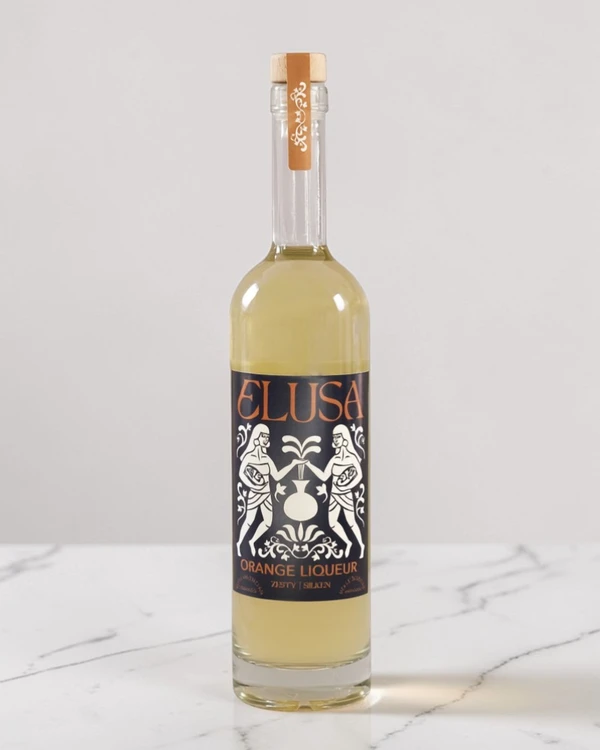
Elusa Orange Liqueur is 21.5% ABV, and for baking that turns out to be close to ideal. It is strong enough to hold the citrus oils in solution and to preserve a fed cake, but soft enough to brush straight onto a warm sponge or spoon over dried fruit without any dilution at all. You use it as it comes.
It is made with Spanish oranges — the whole fruit, juice, zest and pith, not just dried peel — macerated on a Blanche Armagnac base from Gascony. That base is why it works in a fruit cake: the Armagnac brings pear and stone fruit underneath the citrus, in the same register as the raisins, currants and dark sugar already in the tin. The Blanche it is made with is our Great Taste 2-star Blanche Armagnac.
Where it earns its place
Christmas cake. Two jobs: soaking the dried fruit before mixing, and feeding the cake weekly once it is baked. The recipe below covers both.
Mincemeat. Add 50ml per kilo at the end, once the mixture has cooled. Adding it while hot drives off most of the aromatics and wastes the preservative effect.
Marmalade. Stir 2–3 tablespoons in after the setting point is reached and the pan is off the heat. It lifts a marmalade that has gone slightly flat from long boiling.
Chocolate orange bakes. Replace part of the liquid in a brownie or loaf batter, or brush it over the sponge while still warm. Chocolate and orange work through shared aromatic compounds, and alcohol is what carries them.
Simnel cake. Lighter and less spiced, so the citrus is more exposed. Use it in the fruit soak rather than as a feed, and keep the quantity modest.
Christmas Cake Fruit Soak and Weekly Feed
Enough for a 20cm round cake. Start the soak the night before you bake — 24 hours is better, and up to three days is fine if you stir it daily.
- 500g mixed dried fruit (raisins, sultanas, currants)
- 100g glacé cherries, halved and rinsed
- 100g mixed peel
- 120ml Elusa Orange Liqueur, for the soak
- Zest of 1 orange and 1 lemon
- 1 tsp ground mixed spice
- A further 150ml Elusa Orange Liqueur, for feeding
Put the dried fruit, cherries and peel in a large bowl. Pour over the 120ml of liqueur, add the zests and the mixed spice, and stir well. Cover and leave at room temperature overnight, stirring once if you can. By morning the fruit should be plump with almost no free liquid left in the bowl — if there is any, stir it into the batter rather than draining it.
Fold the soaked fruit into your usual creamed batter and bake low and slow as normal. Leave the cake in its tin until completely cool.
To feed: skewer the top of the cooled cake ten or twelve times, about two-thirds of the way down. Spoon over 25ml of liqueur, let it soak in for a few minutes, then wrap in baking parchment and foil. Repeat weekly for six weeks — that is the 150ml accounted for. Every other week, turn the cake over and feed the base instead, which stops moisture pooling at the bottom. At 21.5% it goes on neat: no thinning with juice, no harsh edge to rest out before icing.
A note on quantity
More is not better. Alcohol is a tenderiser, and past a certain point a batter loses structure and bakes greasy. Keep added liqueur under about 10% of the total liquid in a batter. For feeding there is more latitude, but 25ml a week on a 20cm cake is plenty — beyond that the crumb goes soggy rather than moist and the citrus starts to read as bitter.
The short answer
For baking, you want an orange liqueur made from whole fruit rather than peel extract, on a base spirit that adds something rather than nothing, at a strength you can use undiluted. That last point is the one most guides skip. A 40% triple sec is built for cocktails, where dilution is part of the method. A liqueur at 21.5% is built to be tasted, which is also what a cake needs.
For what the same bottle does outside the kitchen, start with an Orange Spritz. If you are comparing brands, we have written separately on Cointreau alternatives and the best orange liqueur for a margarita.
For the Christmas bake
Elusa Orange Liqueur. 700ml, 21.5% ABV. Whole Spanish oranges on a Blanche Armagnac base from Gascony. Shipped across the UK.